

Technology has transformed the way the world consumes media—and art is no exception. Today, museums around the globe have embraced technology as a means of enhancing the visitor experience. So, when the American Kennel Club (AKC) decided it was time to return the Museum of the Dog (MOD) to its New York City roots, they saw the move as the perfect opportunity to bring the museum into the 21st century.
Located in the center of busy Midtown Manhattan on the ground and third floors of 101 Park Avenue, the Museum of the Dog has undergone a makeover after 30 years in St. Louis, Missouri. Visitors encounter 180 canine-related artworks as they enter the new area—including a 2,000-year-old paw print—alongside 18-foot-high ceilings, terrazzo flooring, a large mezzanine, and a retail store. A central stairway connects the levels, and the glass façade of the structure lets light flood the room.
A Digital Twist
However, for AKC, moving the Museum of the Dog was as much about improving the experience of their guests as it was about designing a stunning physical space. The objective was to provide as much instruction as possible while creating a distinctive and captivating experience. To do this, AKC collaborated with Gensler to integrate custom interactive tech components.
Digital silhouettes of dogs appear to parade down Park Avenue alongside pedestrians even before visitors enter. Anthony Crawford, the project manager for Structure Tone New York, recalls watching people react during the commissioning phase because the element looked so realistic. He notes that most New Yorkers walk while staring at their phones. “How did we get the dogs up there behind the screen?” one woman asked.
Upon entering, guests can have their photos taken at one of two kiosks to discover which dog breed they most closely resemble. AKC even created digital puppies, Arty and Molly. The “Train a Dog on the Job” station allows visitors to teach Molly to respond to voice commands, while Arty engages younger guests through a Pokémon GO-style scavenger hunt.
Tight Quarters, Big Vision
Although these features make the museum experience unique, one of the biggest challenges was fitting the technology, artwork, and design elements within the museum’s 15,000 square feet.
Logistics
Installing a three-stop hydraulic elevator and a three-story staircase proved especially difficult. Moving the large equipment and materials required for both elements was complicated by the building’s footprint. To solve this, the full project team—including design and construction partners, specialized subcontractors, and MEP trades—met multiple times to coordinate strategy.
Ultimately, the team decided to reposition the stairway and elevator to optimize available space. They also adjusted the staircase by removing a few risers and adding multiple landings. The result is a stunning architectural centerpiece with glass rails and terrazzo treads. “A big vitrine wraps around the stairs,” Crawford explains. “You get a close-up look at all the artifacts and exhibits as you ascend.”
Artwork
Fitting all 180 pieces of art—many of them three-dimensional—into the compact space presented another challenge. With the glass façade occupying one wall, display options were limited. The team installed seven steel-framed, 360-degree rotating panels that resemble oversized easels. These rotating displays maximize space and give the museum flexibility for hosting special exhibits and events.
A United Collection
One of AKC’s main reasons for relocating the museum back to New York was to reunite its growing art collection. Previously, the organization’s offices and a significant portion of its archives remained in Manhattan, while much of the museum’s artwork resided nearly 1,000 miles away in St. Louis. By moving the museum and its offices to 101 Park Avenue, AKC could showcase its full 2,500-piece collection and refresh its headquarters at the same time.
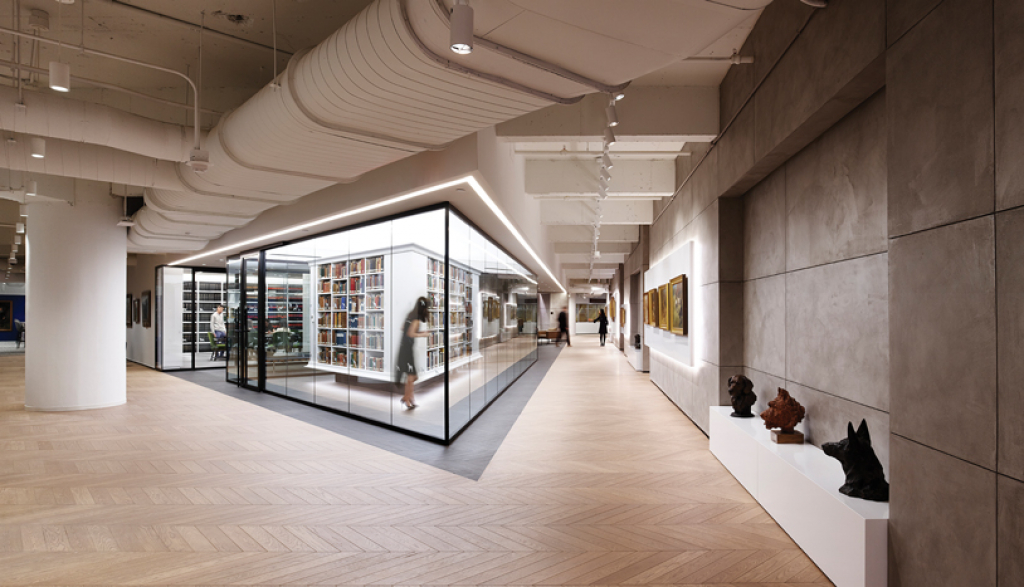
The redesigned office now features executive suites, breakout areas, a high-tech boardroom, and three distinct libraries. Many canine-themed artworks are on display, starting with a striking collection of hand-carved canes in the main lobby—each donated by an AKC supporter.
A New Chapter of Success
Since its reopening, the Museum of the Dog has thrived in its new location. In Missouri, the museum drew an average of 300 to 400 weekly visitors. Now, it sees up to 800 guests on weekends and averages 1,000 visitors per week—proof that its dynamic space, interactive features, and central location have made it a hit with dog lovers and museumgoers alike.
Project Details
Size: 40,000sq
Client: American Kennel Club
Ownere’s Rep: VVA
Broker: Cushman & Wakefield
Architect: Gensler
MEP Engineer: Syska Hennessy Group
Structural Engineer: Gilsanz Murray Steficek
Sector: Cultural/Commercial
Completion: February 2019
Project Highlights
- 135,000 total worker hours on the job
- IFMA Award for Excellence Winner
- 180 pieces of art displayed
- Three unique libraries
