

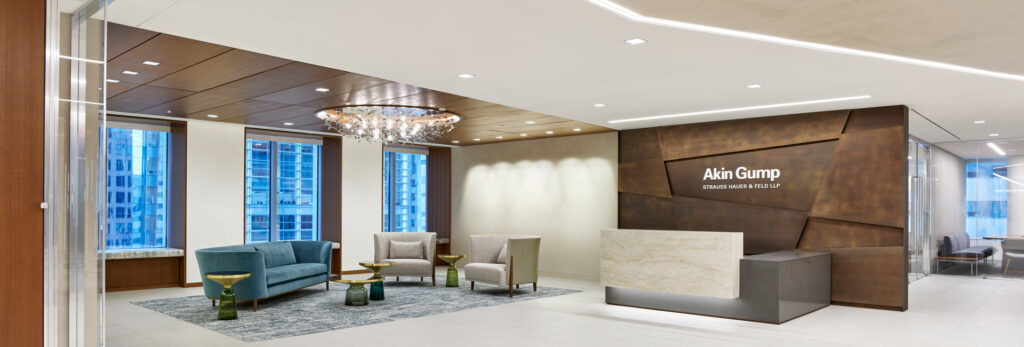
Law firms have traditionally followed a conservative office aesthetic, often rooted in more than a century of legacy. While design trends come and go, this style has remained steady. However, recent years have brought extraordinary challenges and shifts in workplace dynamics. As a result, some new design tendencies are beginning to emerge.
According to Mallory Wall, a project executive at San Francisco’s BCCI Construction, “Our business truly got established with law offices.” BCCI has delivered several law firm projects each year for over 35 years. While every firm has its own needs and preferences, some consistency has emerged in the industry—especially amid ongoing workplace uncertainty after the pandemic.
The crucial query? How to manage going back to work after COVID. A new, more adaptable business model has started to be adopted by several industries. The legal community is still unsure about how to respond to it.
According to Luke Thomas, director of operations at Structure Tone Philadelphia, “Other companies now design spaces just for collaboration and meetings.” They continue their day-to-day work from home.” He added, “We’re beginning to see that reflected in their projects. However, law firms haven’t typically been as open to that kind of change.”
“The competition for skill is one reason,” Wall explains.As large tech companies hire them directly, law firms are losing recruits. We can provide some guidance on how they can convey a more contemporary mood that is most like to that of a tech company because we work with both tech firms and law firms.
THE SHIFT
Law companies were beginning to add additional café rooms and informal collaboration places even before the pandemic. Law firms are stepping up those amenities in response to increased pressure to project an appealing culture.
As absurd as it may sound, Wall says the best way to recruit and retain employees is simply to ask what they want. Many clients struggle to decide whether to adopt modern workplace amenities or stick with tradition. We recommend surveying employees to hear their opinions directly. Clients are often surprised to find that employees care more about lounge areas, break-out rooms, and better facilities than bean bag chairs or ping pong tables. These small upgrades can make a significant impact on satisfaction and retention.
THE LESSONS
It became clear that the businesses in the STO Building Group could benefit from and learn from one another as they continued to assist law firm clients in navigating this paradigm shift in the workplace. This led to the creation of the organization’s legal firm program. Representatives from all 13 of STOBG’s businesses, including BCCI and Structure Tone, get together frequently to talk about trends, exchange best practices, and make connections for clients wishing to expand or construct offices in different cities. The advantages are already evident for certain clients.
“Our relationship with Gunderson Dettmer is excellent,” Wall states.”We were able to introduce them to our Structure Tone Southwest team when they indicated they were starting a project in Austin, Texas, and we remained involved and engaged throughout the project.”
The same is true when navigating the supply chain’s growing difficulties. Procurement specialists at STO Building Group track trends and issue monthly reports. These reports highlight which products are causing supply chain delays and which may help ease them. The broader STOBG network has provided valuable insights that continue to support smarter decision-making across project teams.
“The information a team in one city has been able to share with colleagues in other locations has undoubtedly benefitted our clients’ processes,” says Eugene White, STO Building Group executive vice president and leader of the firm’s law firm initiative. “From supply chain challenges to local market nuances, it’s been extremely helpful to have that level of expertise behind our local teams. Advancing lessons learned from one project to another has helped us ensure more predictable outcomes.”
The efficiencies a client gains from working with this network of experts create a win-win for everyone. “The client has a great experience,” says Wall. “And we get to build even stronger relationships with our sister companies. Our clients tell us it feels just like working with the local team they know and love.”
THE FUTURE
Law offices will surely continue to reflect tradition, reputation, and professionalism even though the crystal ball does predict certain changes in the future of law firm architecture and construction. Striking the ideal balance is the challenge.
“The days of the typical law firm are over,” Wall asserts. “Culture will be important throughout this transitional moment.”
Luke Thomas concurs.”In terms of building opulent offices for lawyers, I think legal companies will go toward more communal areas for all and less hierarchy. Though it will take time, they are making progress.
