Developers have significantly increased the number of outpatient healthcare facilities in recent years. Well-informed patients are looking for convenience, quality, and choice. They’re discovering that outpatient specialist clinics—often located in their own neighborhoods—offer excellent care at lower costs than hospitals.
According to LF Driscoll Healthcare (LFDH) project manager Kristopher Pomilla, the trend started in early 2019, just prior to the COVID pandemic.
He states that current hospitals lack the space to expand their facilities, and that their clients have been discussing new medical technologies, consumer outreach, and support in urban and suburban locations. “As an economical and sustainable means of satisfying that demand, we are witnessing an increasing trend in the conversion of vacant commercial buildings into healthcare facilities.”
FINDING THE RIGHT BUILDING
According to Pomilla, the planned purpose determines which type of structure is best suited for conversion. Developers can transform multistory buildings into spaces that support a range of medical specialties and auxiliary laboratories. They are also repurposing mall anchors and vacant big-box stores—like Lord & Taylor or Sears—into ambulatory care centers offering outpatient services such as dialysis clinics, surgery centers, cancer treatment facilities, and physician offices. This approach also reduces the building’s embodied carbon impact.
The best buildings for medical repurposing should be easily accessible by public transportation or offer plenty of free parking. Pomilla advises clients to have a geotechnical assessment and soil boring testing before purchasing a building for conversion. Documenting the current state of the façade and windows on the outside is also crucial. Many commercial leases are triple net, meaning that the tenant is responsible for building upkeep, insurance, and taxes. If existing issues that require repair are not documented, the project’s cost may increase.
Additionally, converting a standard storefront or office structure into a healthcare center calls for careful design and specialist skills. Using Department of Health (DOH) procedures or Facility Guidelines Institute (FGI) criteria, the completed facility must satisfy essential needs for healthcare facilities, such as specific plumbing, HVAC, and electrical systems. The building is usually gutted to a white box stage and equipped with brand-new MEP.

One of the important procedures, according to LFDH project executive Scott Frank, is the examination and thorough examination of each wall prior to closure. “We make sure that the wall cavity’s interstitial space has been thoroughly cleaned and that there is never any concealed dust or debris that can endanger a patient’s health in the future.”
CONVERSION IN ACTION: SUMMIT HEALTH IN GARDEN CITY
In February 2023, LFDH finished converting an existing 28,000 square foot, three-story office building into a cutting-edge medical center for Summit Health, which serves patients in Garden City, Long Island, at a cost of $18 million. Today, the building houses primary care, orthopedic, podiatry, cardiology, dermatology, ENT, and a pain management clinic. There are five X-ray rooms, a CT scanner, and an MRI machine in a lower-level radiology suite.
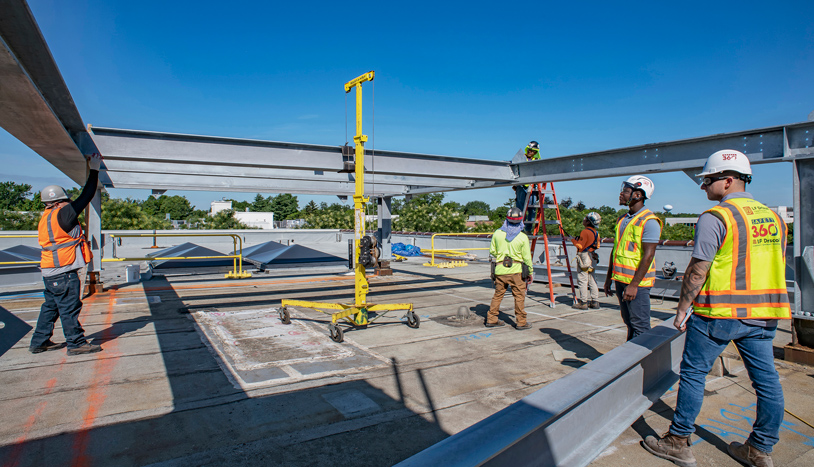
The team completed a year-long project that involved a full gut renovation. This included removing all MEP services back to their entry points. They installed all new electrical service gear to support the added load from the radiology equipment and the new elevator. The crew also added new boilers, water heaters, ejector pits, and fire protection systems. The design included replacing an old staircase with a new stairwell.
The success of the initiative depended on LFDH joining at the program stage. The group found long-lead components and made early purchases, which reduced costs significantly and sped up delivery. Additionally, they helped the owner and design team obtain permissions and approvals from local authorities. In order to fully comprehend the current building conditions, the team lastly created an early demolition and building assessment program.
Early involvement also aided the team in recognizing and resolving possible issues, particularly with the soil. The building’s lowest floor is below grade, and Long Island’s soil is extremely sandy. “Sand filled the hole as soon as we dug,” Pomilla explains. In order to maintain the existing foundation and hold back the earth while they dug, the team vibrated lagging boards into the ground.

Additionally, some contaminants had tainted the soil. According to Frank, “we had a certified cleanup crew carefully standing by to remove the soil whenever we excavated for plumbing, electricity, and the lighting protection system.”
In the end, LF Driscoll Healthcare’s team has brought the benefits of building repositioning to life. They’ve helped a major healthcare network expand its services into an entirely new neighborhood. According to Pomilla, “These kinds of projects show how construction may play an essential role in future patient outcomes.”
Project Details
Location: Garden City, NY
Client: Summit Health
Size: 28,489sf
Architect: FCA
Engineer: Syska Hennessey Group
Sector: Healthcare